
Passport strength is typically measured by mobility privilege, reflected in visa-free and e-visa arrangements. Ease of entry remains the decisive factor even when assessment criteria broaden.
Travel freedom is highly desirable for both tourism and business, but it can easily disappear when systems or stability collapse. The COVID-19 pandemic and recent conflicts revealed a fundamental blind spot in conventional passport strength evaluations. A document that facilitates entry in peacetime but fails to secure nationals in distress cannot be considered truly strong. In a turbulent world, the key question is no longer how far a passport takes its nationals, but whether the State can bring them home.
Sovereign Assurance of Retrieval (SAR)
The FuturisIndia SAR Lens defines passport strength as a State’s duty to locate, assist, and retrieve nationals facing extreme jeopardy anywhere in the world. SAR activates when three conditions are met:
- life, liberty, or physical safety of a national is at serious risk abroad;
- extreme jeopardy exists, including but not limited to major crises, armed conflicts, targeted violence, or coercive or unlawful captivity;
- standard mechanisms such as consular or legal assistance are exhausted, inadequate, obstructed, or unavailable.
Jeopardy may arise in cooperative or non-cooperative contexts, involve State or non-state actors, and occur under functioning, hostile, or absent authority. SAR operates within the bounds of international law, proportionality, and judicious statecraft, solely to bring nationals home. Its long-term sustainability rests on reciprocity through responsible individual conduct; while retrieval is unconditional at the point of peril, non-reciprocity incurs post-retrieval accountability.
SAR is not a tactical contingency triggered by isolated instances. It is a continuous, principled assurance – an enduring symbol of the bond and belonging between State and people. It shifts focus from the arithmetic of access to the calculus of State reliability. Dependability under duress transforms a passport from a travel document into an instrument of trust, representing the State’s guarantee to its people.
The 3Cs of Sovereign Assurance
Commitment: Sovereign Will
Non-abandonment is the ethical core that shifts retrieval from discretion into duty. The State expects responsible conduct and caution from its nationals, and in return, guarantees untiring effort to retrieve them, regardless of number, location, or circumstance. Failure, if it occurs, is not a result of abandonment or unpreparedness, but of insurmountable barriers.
Capability: Retrieval Machinery
An integrated system that converts sovereign will into decisive action. It draws on diplomatic reach, multi-domain negotiation leverage, responsiveness, and operational capacity sufficient to deploy quickly and concurrently across different regions and threat scenarios.
Continuity: Institutional Endurance
Retrieval as a standing sovereign function with automatic activation upon defined thresholds. Embedded in legal mandates and supported by dedicated budgets and standing protocols, it transforms non-abandonment into durable reliability that survives leadership changes and adapts to emerging vulnerabilities. Endurance requires clarity and boundaries – both State and individual responsibilities.
The 3Cs form a reinforcing triad. Commitment establishes the duty, Capability executes it, and Continuity guarantees its immediate activation and endurance. Together they bridge the functional distance between a national’s distress and the State’s reach.
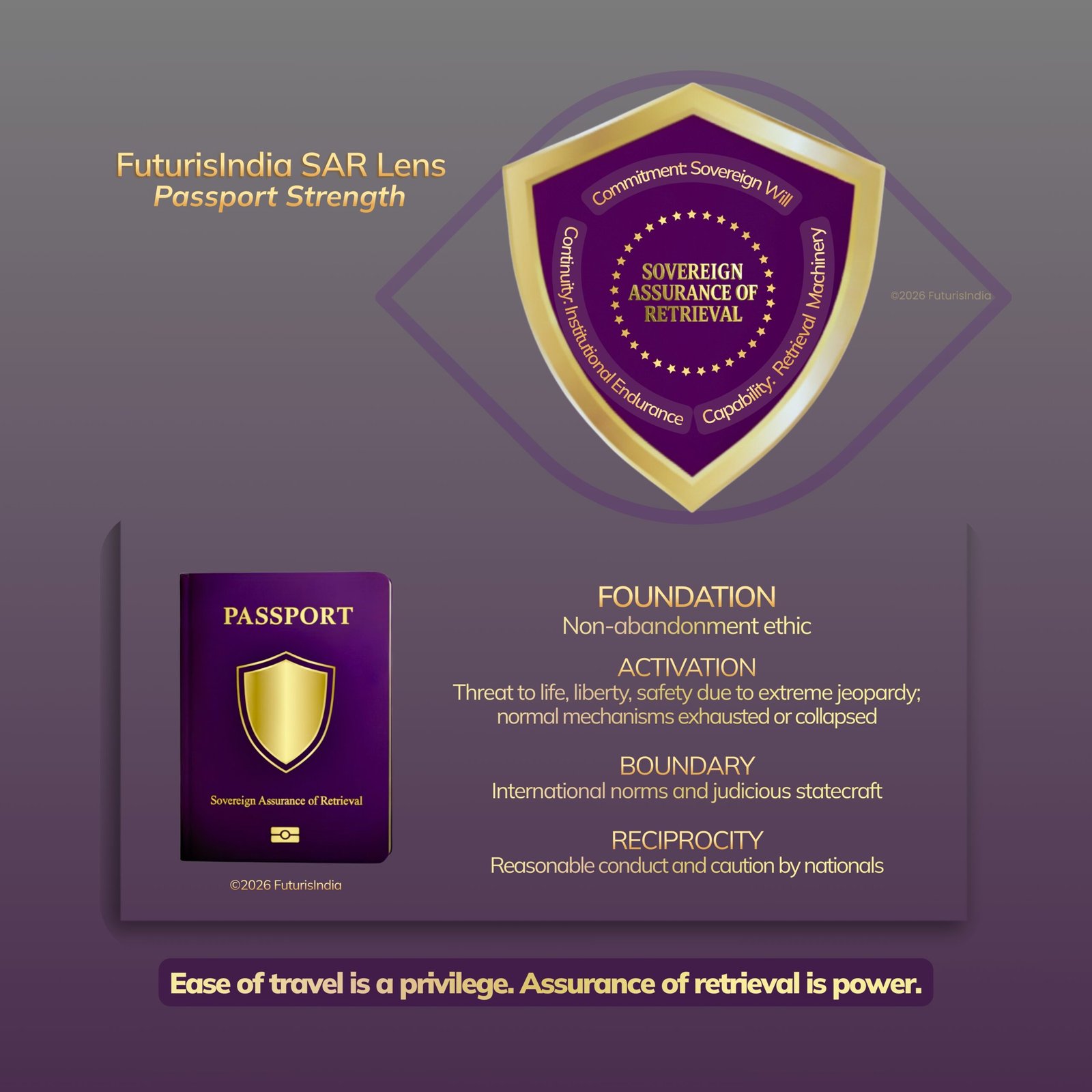
SAR Lens is not a ranking index or a discretionary NEO (Non-Combatant Evacuation Operation). It is not a justification for reckless conduct or coercive power projection. SAR is duty-anchored to all nationals, and grounded in the ethical principle of non-abandonment and the relational bond between State and people.
The SAR Lens: India
India serves two purposes: a conceptual clarifier that delineates core concepts under real-world conditions, and a demanding stress-test of lens robustness.
- Footprint: Over 9 crore valid passports, ~3 crore annual outbound travellers, and ~1.7 crore Non-Resident Indians, creating one of the world’s largest protection responsibilities.
*1 crore = 10 million - Exposure: High, global, and continuous, spanning stable, fragile, and collapsed environments. Nationals often ignore advisories, due to economic or academic reasons, or optimism bias.
- Constraints: Multi-layered administration; democratic and foreign-policy red lines; intense media and public scrutiny, fiscal and resource limitations, absence of a formal retrieval doctrine, and strategic restraints on military power projection and diplomatic coercion.
- Passport: Ranked between 71st and 90th on a conventional passport ranking index over the past two decades.
On paper, these compounding constraints create a scenario ripe for failure. In practice, India has built a strong retrieval record across time, scale, and the full spectrum of extreme jeopardy scenarios.
Demonstrated Capability: Spectrum of Retrieval Reach
India has retrieved nationals from high-threat scenarios across the world.
- Mass and Micro:
- State and non-State:
- 46 nurses (ISIS, 2014)
- Jesuit priest (Taliban, 2015)
- Uzma Ahmed (forced marriage in Pakistan, 2017)
- Eight Navy veterans (Qatari death row, 2024)
- Multiple extractions from pirate captivity
- Mobility Corridors in Active Conflict:
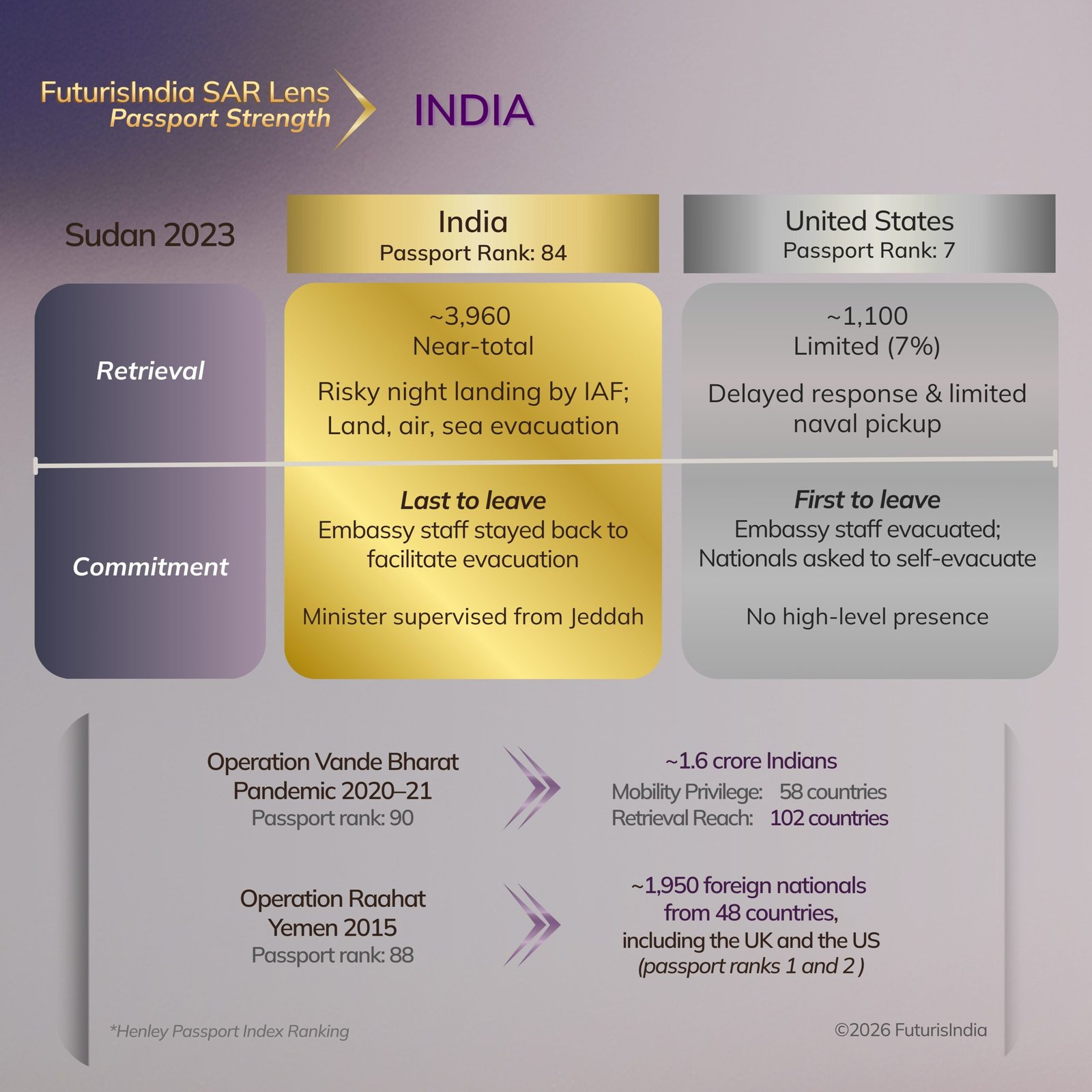
- Yemen (2015): Embassy remained operational despite bombardment. Negotiations with Saudi Arabia and Houthis secured air and sea access denied to most nations, eventually evacuating ~4,750 Indians.
- Retrieval of Foreign Nationals: India retrieved ~1,950 foreign nationals belonging to 48 countries during the Yemen crisis; 33 of those nations had formally requested assistance. This included those holding top-tier passports such as the UK and the US. Such retrievals of foreign nationals – including from the COVID-19 epicentre Wuhan and during several anti-piracy missions – generate diplomatic equity.
- Large-Scale Civilian Repatriation:
- Operation Vande Bharat (2020–21) highlights India’s reach, scale, and endurance, spanning 16 months to bring home 1.6 crore nationals.
- India’s contemporaneous mobility privilege, 58 countries; India’s retrieval reach amidst global systemic collapse, 102 countries.
- It also illustrates a retrieval model in which the State leads access, coordination, and logistics, while travel costs are borne by nationals.
Commitment Interpreted Through Action
India lacks a written doctrine but consistently shows up, regardless of peril or geography. While occasional delays occur, the State’s actions prove its commitment to retrieve.
- Top leadership intervention: the Indian Prime Minister spoke with the Afghan President four times to secure the release of Judith D’souza from Taliban captivity (2016). His telephonic engagement with the Presidents of the two warring countries secured a safe passage for students from Ukraine (2022). Ministers are deployed to active theatres or adjacent nations to coordinate; for instance, the Minister of State for External Affairs went to Sana’a to oversee extraction (2015).
- It also deploys and expends resources when needed: 14 Indian Air Force (IAF), 76 commercial flights at a cost of ~INR 116 crore (Operation Ganga, Ukraine), and 18 IAF, 20 commercial flights and 5 naval sorties at a cost of ~INR 46 crore (Operation Kaveri, Sudan).
- The State is protective, at times bordering on indulgence. Under Operation Sindhu (Iran, 2025), the Indian mission facilitated the door-to-door evacuation of several students and supervised their safe passage. Operation Ganga allowed evacuating nearly 200 pets because nationals would not leave without them. The State retrieves even when advisories are ignored – a priest who travelled to Yemen against official advice and was later kidnapped; this highlights the State’s unconditional guarantee but lack of individual reciprocity and post-retrieval consequences.
- Failure to Retrieve, Not Abandonment: To trace 39 Indian workers captured in Mosul by ISIS (2014), India pursued every possible channel for four years. It absorbed domestic backlash for keeping families hopeful, but did not close the case until remains were finally located, confirmed, and repatriated. It was a failure to save, but an unequivocal refusal to abandon. SAR does not define commitment by outcome, but by exhaustive, sustained effort.
The Institutional Continuity Gap
India’s record of bringing nationals home is impressive because commitment is deeply internalised.
- Its missions frequently adhere to an unwritten ‘Last to Leave’ principle, staying operational even after other embassies withdraw. In Sudan (2023), personnel escorted evacuees over 1,200 km through violence-affected areas. In Ukraine (2022), two senior diplomats went to Sumy to personally escort students from an active multi-actor conflict zone.
- While such actions reflect extraordinary commitment, they also reveal compensatory load-bearing driven by moral reflex and political resolve in the absence of institutional endurance.
- Under the SAR Lens, India’s retrievals reveal the hidden fragility of success without institutionalisation. Without standardised protocols, automatic activation, clear boundaries, and impersonal mechanisms:
- Each operation remains ad hoc, with potentially high human and strategic risk-taking.
- Response speed varies – faster for concentrated, high-signal groups than for dispersed or low-visibility ones.
- Activation thresholds remain ambiguous, making the line between extraordinary retrieval and routine consular assistance unclear and susceptible to political or public pressure.
- Reciprocity, the responsible conduct by nationals that underpins retrieval sustainability, is underemphasised. This may encourage recklessness or create a sense of entitlement, distorting expectations and straining the system.
- In India’s case, the gap is not about retrieval. It is about the success trap of high public expectations and rising strategic costs without a clear and standardised playbook. SAR Continuity is institutional maturity that formalises duty without diluting resolve to prevent vulnerabilities inherent in ad hoc overperformance.
India Case Study: Key SAR Insights
- Commitment, even when uncodified, forecloses bad-faith abandonment citing constraints as exit ramps or justifications for inaction.
- In India’s case, its multi-aligned diplomacy gains it access in difficult situations: 2025 simultaneous evacuations from Iran and Israel, securing safe passage in 2022 from both Ukrainian and Russian administrations, or opening channels to non-state actors like the Houthis in 2015 Yemen. These examples demonstrate that successful retrieval often depends on diplomatic equity, negotiation bandwidth, and judicious statecraft to navigate complex authority structures, adversarial actors, and non-conducive environments without sovereign violation.
- SAR Continuity is not about making retrieval possible; it is about durable, systemic reliability and long-term sustainability.
- Public pressure during visible jeopardy – on India during the Qatar detentions and on the United States during the Sudan evacuation – reveals that expectations of State-led retrieval are inherent, not culturally or politically contingent.
- India’s record, despite its compounding constraints, demonstrates that retrieval is not a function of power or privilege, but of a State-people bond.
Sovereign Assurance in Extremis
The FuturisIndia SAR Lens goes beyond passports, providing the conceptual framework for retrieval as a standing sovereign duty.
Non-Abandonment as a Universal Ethic
Non-abandonment has universal latent legitimacy. It also survives the scale, ideology, and resources of different States. Commitment is universal; Capability and Continuity are designed proportionally to each State’s context and responsibility.
The Power of Ethics
The SAR Lens aligns sovereign ethics with strategic self-interest through a positive, reinforcing loop. When nationals are consistently retrieved from peril, it produces:
- Credible Deterrence: the State signals seriousness to the world, making targeting its nationals costly.
- Domestic Legitimacy: strengthens the social contract by earning trust through maximal efforts to retrieve nationals from extreme jeopardy.
- Economic Security: protects diaspora mobility and consequent remittance flows, especially in high-risk regions.
- External Standing: valuing nationals earns diplomatic credibility in international engagements.
Abandonment, by contrast, is costly, compounding reputational damage and domestic distrust.
Strength Redefined
Conventional passport indices measure revocable privileges granted by other States. The SAR Lens defines passport strength as a sovereign, non-delegable assurance, designed for a world marred by crises, conflict, and geopolitical friction. Visa-free counts capture consumer convenience; SAR assures State performance under duress. SAR transforms the passport from a document of access into a manifestation of sovereign reliability under maximum stress. Without the Sovereign Assurance of Retrieval, freedom to travel, study, or work abroad remains fragile in an uncertain world. True power is not in ease of entry, but in the certainty of retrieval.
As per our Terms of Use, limited content (text and audio-visual) may be shared with proper credit. Full reproduction in any format is strictly prohibited. See Clause 5 for detailed usage and attribution guidelines.